Open In Colab

Overview

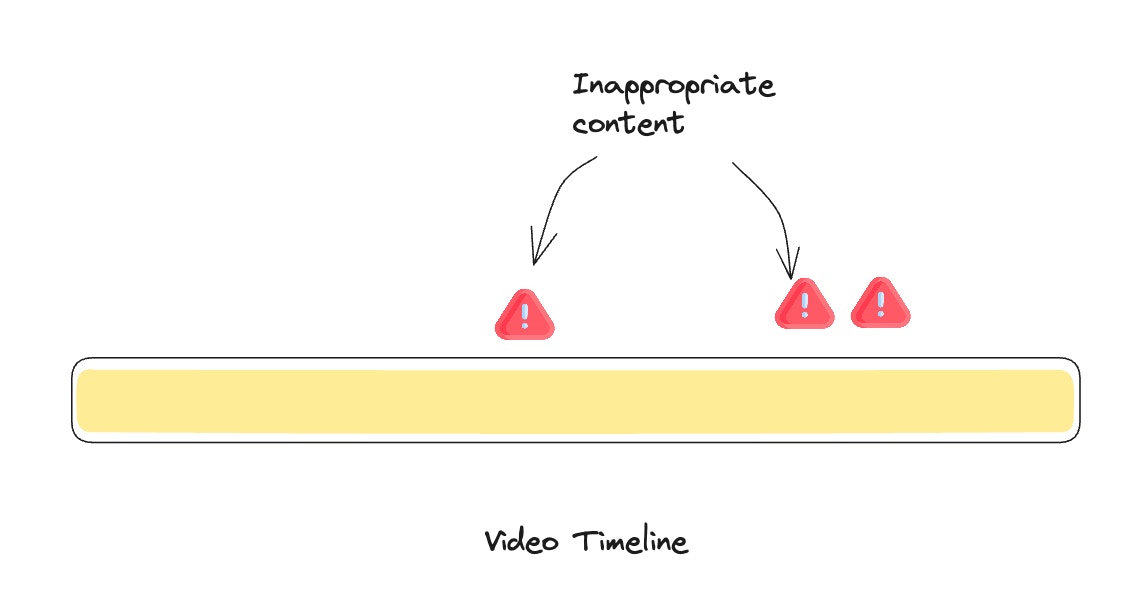
VideoDB’s Timeline Architecture makes it easy to personalize content to meet users’ requirements. If users prefer not to include curse words in their content, VideoDB allows for these words to be either removed or replaced with a sound overlay such as beep sound. This task, typically complex for video editors, can be accomplished with just a few lines of code using VideoDB. This technique can also serve as a valuable Content Moderation component for any social content platform, ensuring that content meets the preferences and standards of its audience. Example of inappropriate content detection and filtering Let’s dive in!
Prerequisites

Install Dependencies

pip install videodb
You’ll also need a VideoDB API_KEY, which can be obtained from the VideoDB console.

Connect to VideoDB

Connect to VideoDB using your API key. This establishes a session for uploading and manipulating video and audio files:
import videodb

# Set your API key
api_key = "your_api_key"

# Connect to VideoDB
conn = videodb.connect(api_key=api_key)
coll = conn.get_collection()

Source Content

For this tutorial, let’s take the Joe Rogan clip, where he is trying to trick siri into using curse words 🤣
from videodb import play_stream

# Joe rogan video clip
coll = conn.get_collection()
video = coll.upload(url='https://www.youtube.com/watch?v=7MV6tUCUd-c')

# watch the original video
o_stream = video.generate_stream()
play_stream(o_stream)

Index the video

Find out the curse words with the spoken Index.
# index spoken content in the video
video.index_spoken_words()

Create Beep Asset

We have a sample beep sound in this folder, beep.wav. For those looking to add a more playful or unique touch, replacing the beep with alternative sound effects, such as a quack or any other sound, can make the content more engaging and fun.
# Import Editor SDK components
from videodb.editor import VideoAsset, AudioAsset, Timeline, Track, Clip

# upload beep sound - This is just a sample, you can replace it with quack or any other sound effect.
beep = coll.upload(file_path="beep.wav")

# Create audio asset from beep sound
beep_asset = AudioAsset(id=beep.id)

Moderation

To ensure appropriate content management, it’s necessary to have a method for identifying profanity and applying a predefined overlay to censor it. In this tutorial, we’ve included a list of curse words. Feel free to customize this list according to your requirements.
curse_words_list = ['shit', 'ass', 'shity', 'fuck', 'motherfucker','damn', 'fucking', 'motherfuker']

Get Transcript

Retrieve the transcript from the indexed video to analyze each word:
transcript = video.get_transcript()

Finding the Curse Words

We’ll use few NLP techniques to identify all variations of any offensive words, eliminating the need to manually find and include each form. Additionally, by analyzing the transcript, you can gain insights into how these sounds are transcribed, acknowledging the possibility of errors.
#install spacy
!pip -q install spacy

#install dataset english core
!python -m spacy download en_core_web_sm

# load the english corpus
import spacy
import re
nlp = spacy.load("en_core_web_sm")

def get_root_word(word):
    """
    This function convert each word into its root word
    """
    try:
        #clean punctuations
        cleaned_word = re.sub(r'[^\w\s]', '', word)

        # Process the sentence
        doc = nlp(cleaned_word)

        # Lemmatize the word
        lemmatized_word = [token.lemma_ for token in doc][0]  # Assuming single word input

        return lemmatized_word
    except Exception as e:
        print(f"some issue with lemma for the word {word}")
        return word

Filter words and Create Fresh Timeline

First we will identify the timestamps to beep, and then let’s create a timeline using the Track and Clip pattern. Add the video clip to the main track, then loop through the transcript to add beep overlays wherever curse words are detected.
# 1. Filter and prepare curse metadata
padding = 0.15
curse_intervals = [
    {
        'word': w.get('text'),
        'start': max(0.0, float(w['start']) - padding),
        'end': min(float(video.length), float(w['end']) + padding),
        'raw_start': float(w['start']),
        'raw_end': float(w['end'])
    }
    for w in transcript
    if w.get('text') != '-' and get_root_word(w.get('text')) in curse_words_list
]

# 2. Building the Timeline

from videodb.editor import Timeline, Track, VideoAsset, AudioAsset, Clip

timeline = Timeline(conn)
video_track = Track()
beep_track = Track()
current_time = 0.0

print(f"{'WORD':<15} | {'START':<8} | {'END':<8} | {'DURATION'}")
print("-" * 50)

for interval in curse_intervals:
    # A. Clean segment
    if interval['start'] > current_time:
        clean_dur = interval['start'] - current_time
        video_track.add_clip(current_time, Clip(asset=VideoAsset(id=video.id, start=current_time), duration=clean_dur))

    # B. Muted segment
    mute_dur = interval['end'] - interval['start']
    video_track.add_clip(interval['start'], Clip(asset=VideoAsset(id=video.id, start=interval['start'], volume=0.0), duration=mute_dur))

    # C. Beep overlay
    beep_dur = interval['raw_end'] - interval['raw_start']
    beep_track.add_clip(interval['raw_start'], Clip(asset=AudioAsset(id=beep.id, start=0, volume=2.0), duration=min(beep_dur, float(beep.length))))

    # D. Professional Print Message
    print(f"{interval['word']:<15} | {interval['raw_start']:<8.2f} | {interval['raw_end']:<8.2f} | {beep_dur:.2f}s")

    current_time = interval['end']

# E. Final clean segment
if current_time < float(video.length):
    video_track.add_clip(current_time, Clip(asset=VideoAsset(id=video.id, start=current_time), duration=float(video.length) - current_time))

timeline.add_track(video_track)
timeline.add_track(beep_track)

stream_url = timeline.generate_stream()
print(f"\nProcessing complete. Stream URL: {stream_url}")

Review and Share Your Moderated Video

Finally, watch and share your new stream:
from videodb import play_stream
play_stream(stream_url)

The Real Power of Programmable Streams

If you have videos pre-uploaded and indexed, running this beep pipeline is real-time. So, based on your users’ choices or your platform’s policy, you can use information from spoken content to automatically moderate.

Explore Full Notebook

Open the complete implementation in Google Colab with all code examples.