Open In Colab

CaptionAsset vs TextAsset

FeatureTextAssetCaptionAsset
Timeline SyncNoYes (word-level timestamps)
Data SourceManual text inputAuto-generated from speech
AnimationStatic onlyreveal, karaoke, supersize, box_highlight
FormatFont/Border/Shadow objectsASS (Advanced SubStation Alpha)
CaptionAsset uses ASS format for subtitle rendering, which enables time-synchronized animations and professional subtitle styling.

Auto-Caption Generation

CaptionAsset can automatically generate subtitles from speech in your video. This means you don’t need to manually type out transcripts or time-stamp each word - the system listens to your audio and creates perfectly synchronized captions for you.

Required: Video Indexing

Before using src="auto", you must index the video for spoken words:
video.index_spoken_words()
This is a one-time operation that analyzes your video’s audio track and figures out when each word is spoken. The indexing creates a timestamp map that tells the caption system exactly when to display each word. Without this indexing step, the auto-caption feature won’t have the timing data it needs to work.

Basic Usage

from videodb.editor import CaptionAsset, Clip, Track

caption_clip = Clip(
    asset=CaptionAsset(src="auto"),
    duration=float(video.length)
)

track = Track()
track.add_clip(0, caption_clip)
Example: The caption clip duration should match or exceed the video duration to ensure all words display.

Animation Types

CaptionAsset supports six animation modes that make your subtitles more dynamic:
AnimationEffect
revealWords appear one-by-one as they’re spoken
karaokeActive word changes color (primary → secondary) while speaking
supersizeActive word scales up in size for emphasis
box_highlightActive word is highlighted with a background box
impactOnly the active word appears on the screen
color_highlightActive word highlights with a distinct color for emphasis
Code Example
from videodb.editor import CaptionAnimation

caption_asset = CaptionAsset(
    src="auto",
    animation=CaptionAnimation.karaoke,
    primary_color="&H00FFFFFF",    # White
    secondary_color="&H0000FFFF"   # Yellow highlight
)
Example with CaptionAnimation.karaoke

ASS Color Format

ASS (Advanced SubStation Alpha) is a professional subtitle format that’s been used in video production for years. It uses BGR (Blue-Green-Red) byte order with an alpha channel - which is backwards from the RGB format you might be used to from web colors. This quirk exists for historical reasons in subtitle rendering systems.

Format Structure

&HAABBGGRR or &H00BBGGRR
  • AA = Alpha (00 = opaque, FF = transparent)
  • BB = Blue channel
  • GG = Green channel
  • RR = Red channel

HTML to ASS Conversion

To convert HTML colors to ASS format:
  1. HTML #RRGGBB → Extract RGB bytes
  2. Reverse to BGR order
  3. Add prefix &H00 (opaque) or &HAA (with transparency)
Example: HTML #FF6600 (orange)
  • RGB: Red=FF, Green=66, Blue=00
  • BGR: 00-66-FF
  • ASS: &H000066FF

Common Colors

HTMLASSColor
#FFFFFF&H00FFFFFFWhite
#000000&H00000000Black
#FF0000&H000000FFRed
#FFFF00&H0000FFFFYellow
#00FF00&H0000FF00Green

Styling Parameters

CaptionAsset styling is organized into three parameter groups: FontStyling, Positioning, and BorderAndShadow.

FontStyling

Controls how your subtitle text looks - the font face, size, and whether it’s bold or italic. Think of this as the basic typography settings for making your captions readable and on-brand.
from videodb.editor import FontStyling

FontStyling(
    size=36,          # Font size in points
    bold=True,        # Bold weight
    italic=False,     # Italic style
    name="Arial"      # Font family
)
ParameterTypeDescription
sizeintFont size in points (not pixels)
boldboolBold weight (True) or normal (False)
italicboolItalic style
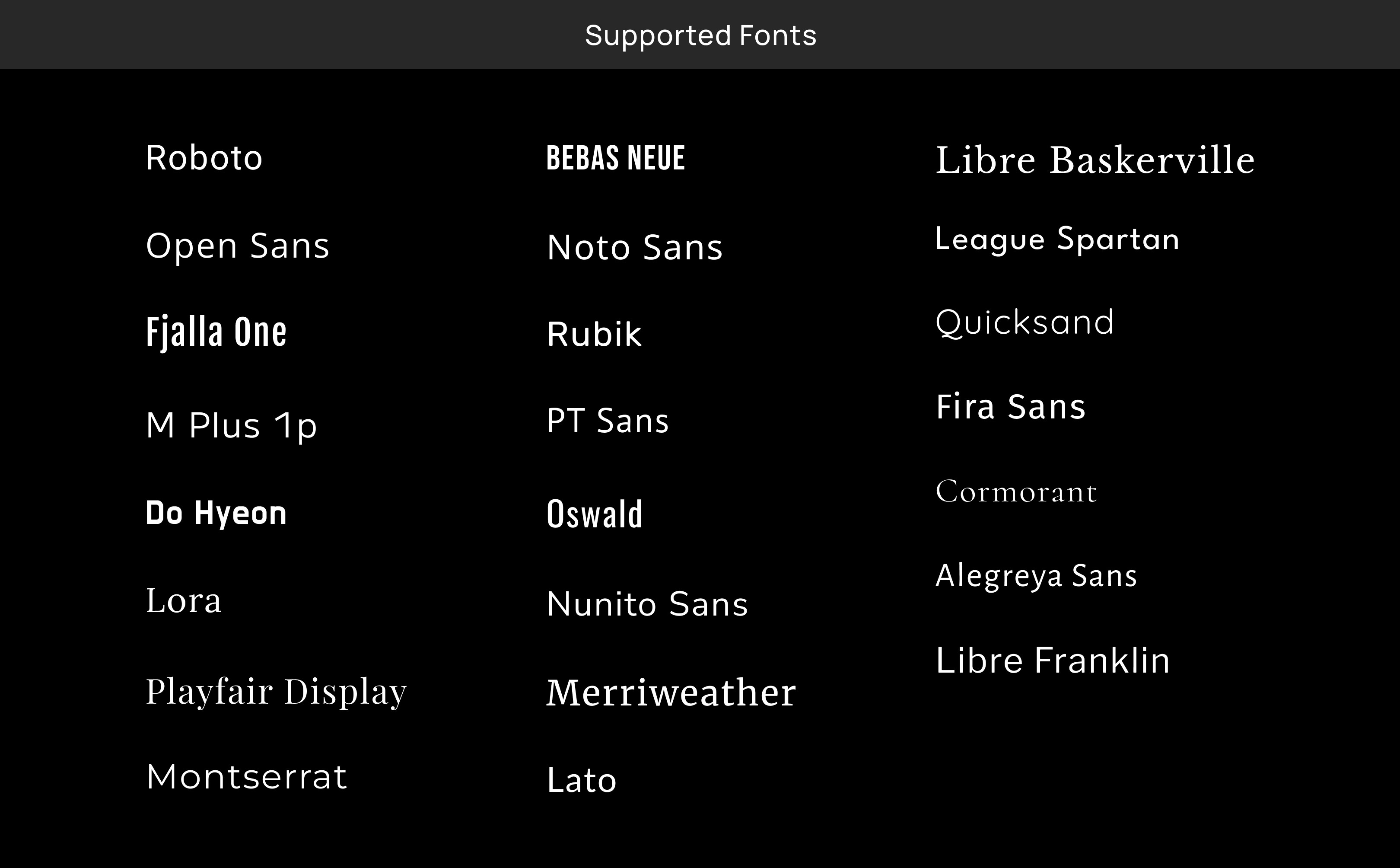
namestrFont family name (must be available on server)
Chart showing all supported fonts for text and caption assets

Positioning

Controls where on the screen your captions appear and how much spacing you want from the edges. You can place captions at the bottom like traditional subtitles, or anywhere else on screen with precise margin control.
Positioning(
    alignment=CaptionAlignment.bottom_center,
    margin_v=100,     # Vertical margin in pixels
    margin_l=20,      # Left margin in pixels
    margin_r=20       # Right margin in pixels
)
ParameterTypeDescription
alignmentCaptionAlignmentWhere on screen the captions appear (see alignment options below)
margin_vintVertical margin in pixels from top or bottom edge
margin_lintLeft margin in pixels from left edge
margin_rintRight margin in pixels from right edge
# Corners
CaptionAlignment.top_left
CaptionAlignment.top_right
CaptionAlignment.bottom_left
CaptionAlignment.bottom_right

# Edges
CaptionAlignment.top
CaptionAlignment.top_center
CaptionAlignment.bottom
CaptionAlignment.left
CaptionAlignment.right

# Center positions
CaptionAlignment.middle_center
CaptionAlignment.bottom_center
Example:
position=Positioning(
            alignment=CaptionAlignment.bottom_center,
            margin_v=50  # 50px from bottom
),
font=FontStyling(
    size=48,
    bold=True,
    name = "Clear Sans",
)

BorderAndShadow

Controls outlines and shadows that make your text readable over any background. These parameters are crucial because subtitles need to be legible whether they’re over bright skies, dark scenes, or complex imagery - borders and shadows ensure the text always stands out.
from videodb.editor import BorderAndShadow, CaptionBorderStyle

BorderAndShadow(
    style=CaptionBorderStyle.outline_and_shadow,
    outline=3.0,                # Outline width in pixels
    shadow=2.0,                 # Shadow depth in pixels
    outline_color="&H00000000", # Black outline (ASS format)
    shadow_color="&H80000000"   # Semi-transparent black shadow
)
ParameterTypeDescription
styleCaptionBorderStyleHow the border/background is rendered
outlinefloatOutline width in pixels around each letter
shadowfloatShadow depth in pixels for drop shadow effect
outline_colorstrOutline color in ASS format
shadow_colorstrShadow color in ASS format
CaptionBorderStyle Options:
  • CaptionBorderStyle.outline_and_shadow - Outline + drop shadow
  • CaptionBorderStyle.opaque_box - Solid background box
Example:
border=BorderAndShadow(
            style=CaptionBorderStyle.outline_and_shadow,
            outline=5,
            outline_color="&H00000000",  # Black outline
            shadow=3
        )

Complete Example

From the notebook, here’s a complete CaptionAsset with all styling parameters:
from videodb.editor import CaptionAsset, CaptionAnimation, Positioning, CaptionAlignment, FontStyling, BorderAndShadow

caption_asset = CaptionAsset(
    src="auto",
    animation=CaptionAnimation.supersize,
    primary_color="&H00FFFFFF",      # White text
    secondary_color="&H0000FFFF",    # Yellow highlight for animations
    position=Positioning(
        alignment=CaptionAlignment.middle_center,
        margin_v=100
    ),
    font=FontStyling(
        size=44,
        bold=True
    )
)

caption_clip = Clip(
  asset=caption_asset,
  duration=100
)

Parameter Reference

ParameterTypeDescription
srcstrSet to "auto" for auto-generation from speech or add manually in .srt or .ass format converted to base64
animationCaptionAnimationAnimation mode: reveal, karaoke, supersize, box_highlight, impact, color_highlight
primary_colorstrMain text color (ASS format: &H00BBGGRR)
secondary_colorstrHighlight color for animations (ASS format)
positionPositioningSpatial placement and margins
fontFontStylingTypography settings
border_and_shadowBorderAndShadowOutline and shadow styling

Next Steps

Caption Asset & Auto Subtitles

Hands-on experimentation with styling options, animations, and color formatting.